
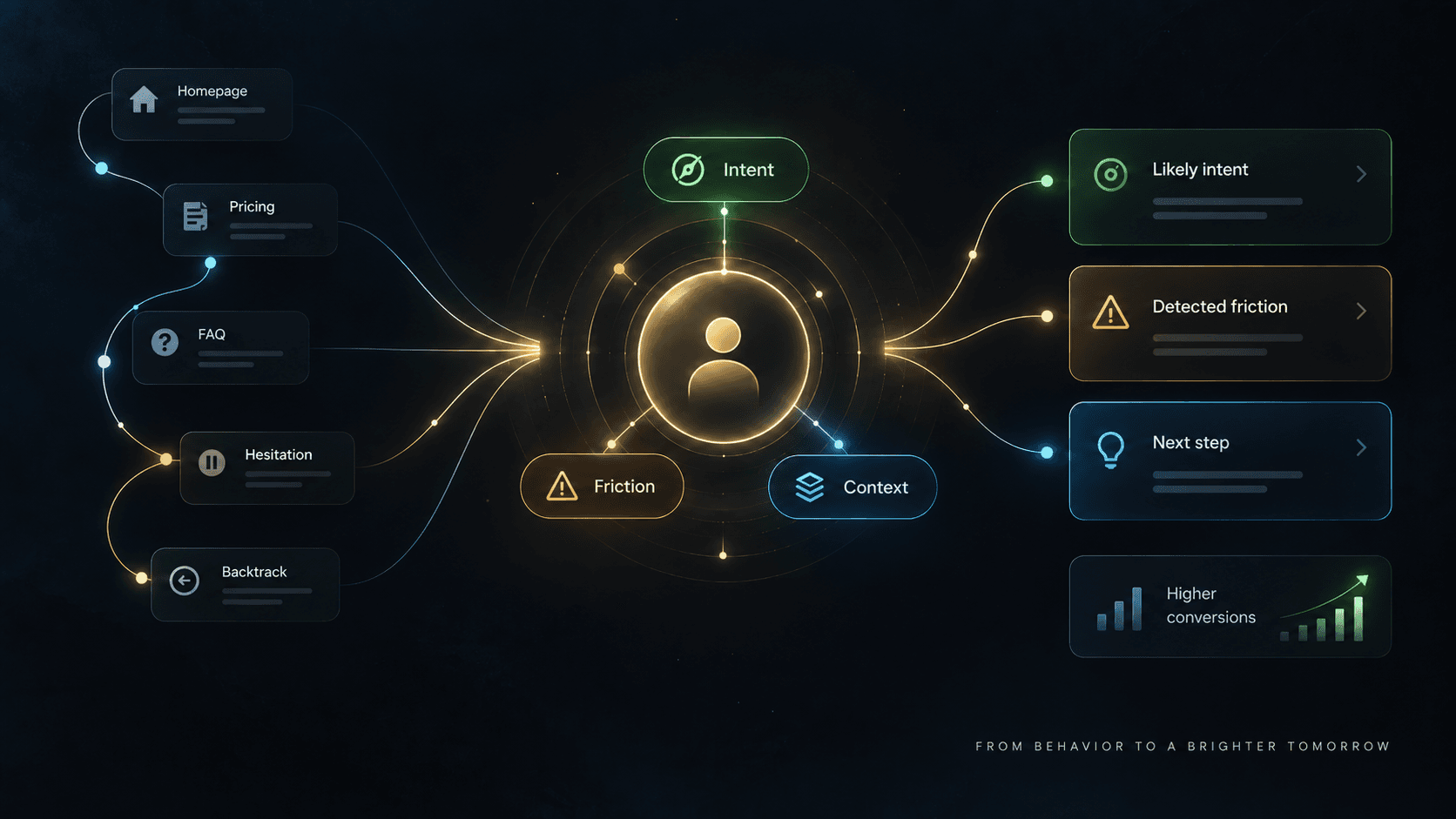
Behavior is more than a sequence of clicks
Traditional analytics records what happened. Session replay lets you watch it happen. Behavior intelligence asks what those actions suggest about a person's goal and the friction in their way.
A visitor who returns to pricing three times, opens the same FAQ, and pauses before leaving is sharing a different signal from someone who simply scans the page and moves on.
The difference matters because the two visitors need different responses. One may need reassurance about value, while the other may simply not be in the target audience at all. Treating both as a single 'bounce' erases that distinction entirely.
Behavior intelligence starts from the premise that every action on a page is a small piece of evidence about intent, and that evidence becomes meaningful only when it is read alongside everything else the visitor did.
How it differs from analytics and replay
Standard analytics excels at aggregation: how many people did X, what percentage converted, how a metric trended over the last thirty days. It is built for scale, not for explanation.
Session replay excels at detail: it shows exactly what one person did, frame by frame. That level of detail does not scale, since no team can watch enough sessions to find every meaningful pattern.
Behavior intelligence sits between the two. It looks at the same granular actions replay captures, but summarizes them the way a human analyst would after watching hundreds of sessions and noticing what repeats.
This is not a replacement for either approach so much as a synthesis: the coverage of analytics, the granularity of replay, and an explanation layer that neither was designed to provide on its own.
Context makes signals useful
One interaction is rarely enough to explain intent. The useful insight comes from connecting actions across a journey and treating uncertainty as part of the answer.
A single dead click could mean many things in isolation. The same dead click, following two failed searches and preceding an exit, becomes a much stronger signal that something specific broke expectations.
This is why behavior intelligence works at the level of the session or the journey rather than the individual event. Patterns that are invisible one click at a time often become obvious once the sequence is considered as a whole.
The result should be a concise explanation a team can act on: what the visitor appeared to need, where confidence fell, and what might remove the obstacle.
Where this leads product teams
Practically, behavior intelligence changes what a weekly product review looks like. Instead of opening with a metrics dashboard, a team can open with three or four named visitor patterns and the friction behind each.
It also changes how experiments get prioritized. Rather than guessing at which page to redesign, teams can rank problems by how many visitors actually experienced the underlying friction.
Support and success teams benefit as well, since recurring confusion that shows up in behavior can often predict the tickets that would otherwise arrive a few days later.
None of this replaces judgment. Behavior intelligence is meant to sharpen the questions a team asks, not to remove the people who have to decide what to build next.