
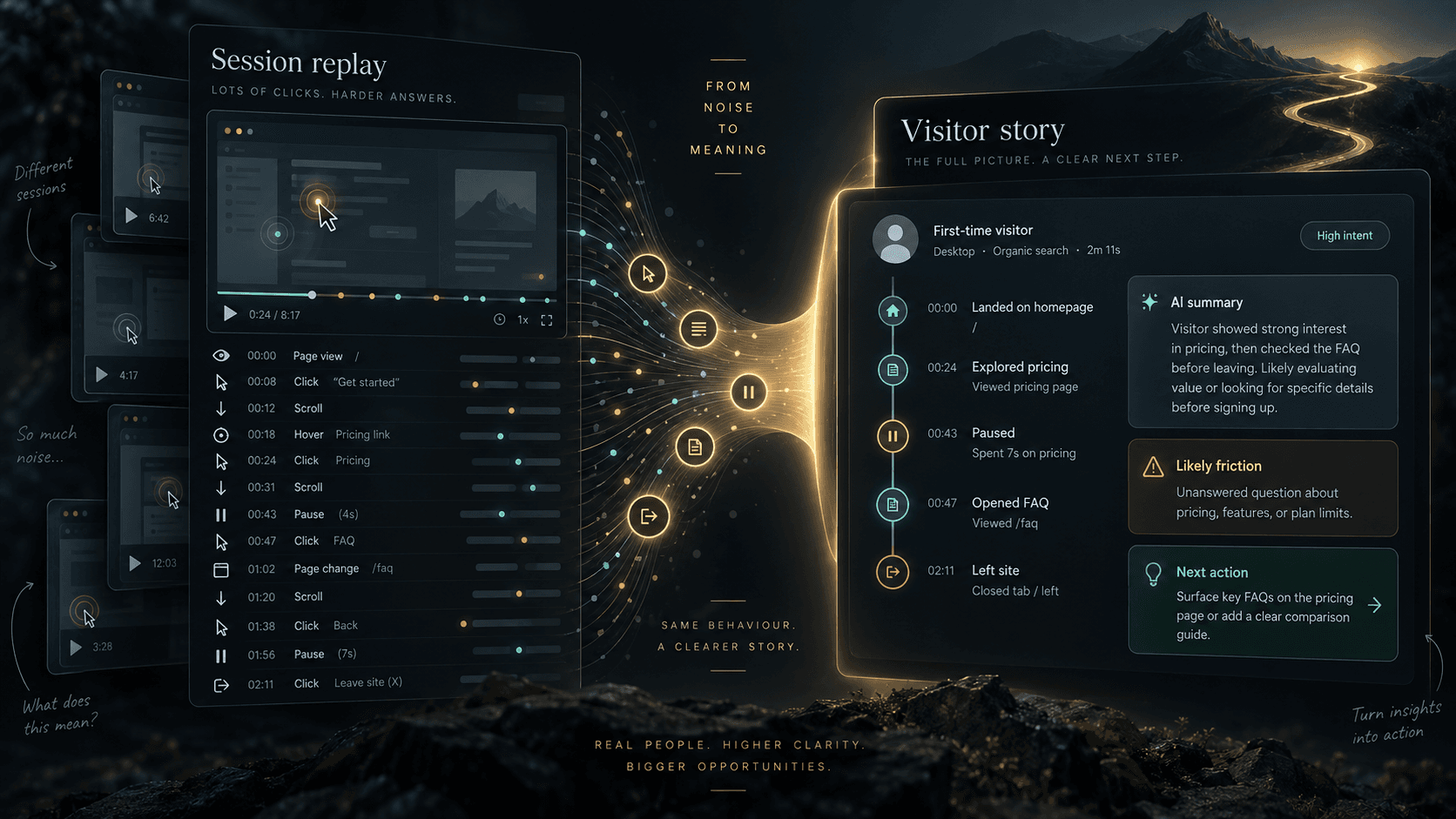
A recording still needs an interpreter
Watching a visitor move through a product can be illuminating. At scale, it also becomes a demanding review process: someone must find the important sessions and interpret each one.
A useful visitor story keeps the meaningful steps while removing noise. It connects the starting goal, the decisions along the way, and the point where progress changed.
Most teams that adopt session replay start with good intentions and end up watching a handful of recordings a week, simply because there is no realistic way to review thousands of them manually.
The sessions that never get watched are not necessarily the least important ones. They are often just the ones nobody had time for, which means valuable friction goes unnoticed indefinitely.
What makes a story different from a recording
A recording is raw material. A story is the result of someone, or something, deciding what mattered in that recording and why.
A good story names the visitor's apparent goal, describes the specific moment things went sideways, and explains what evidence supports that read, rather than leaving the viewer to infer it from thirty seconds of mouse movement.
This reframing turns a fifteen-minute video into a two-sentence summary someone can read in a standup, without losing the substance of what actually happened.
It also makes patterns visible across sessions. A single story is an anecdote; ten similar stories from different visitors are a pattern worth acting on.
Stories should lead to action
The best summary is not a list of clicks. It explains the likely friction and gives the team a sensible next question to investigate or an improvement to try.
That structure makes individual journeys easier to discuss across product, design, and growth teams without asking everyone to watch the same recording.
A story that ends with 'the visitor left the page' is incomplete. A useful story ends with a reason and a next step, such as 'the visitor could not find the discount field and left after two scroll attempts, suggesting the field needs to be more visible.'
This is what turns qualitative research from a report that sits in a folder into an input that actually changes a sprint's priorities.
Scaling storytelling across a whole product
The real value shows up when this approach is applied consistently across every part of a product, not just the page someone happens to be worried about that week.
Onboarding, checkout, settings, and support flows each generate their own stories, and comparing them side by side often reveals which parts of the product are quietly costing the most trust.
Because the summaries are consistent in structure, teams can track the same kind of friction over time and confirm whether a fix actually reduced it, rather than relying on a feeling that things seem better.
Over months, this builds an institutional memory of how real users experience the product, something that is usually lost when the only record of a session is a video nobody has time to rewatch.